How to Build an AppSec Evidence Pack Before the Audit
An auditor asks for proof that the code was tested and its vulnerabilities fixed. Here's a checklist of the artifacts to collect before the audit starts
Content
Make Your Applications Secure Today
Sign up for a personalized demo to see how DerScanner can meet your Application Security needs
DORA, PCI DSS 4.0.1 and ISO 27001 describe application security in different words. But the evidence auditors ask for is often similar:
-
proof that the code was tested
-
a list of the components inside it
-
a record of when vulnerabilities were fixed
-
and other optional details
And software suppliers to banks receive the same requests in due diligence questionnaires, as we've covered in DORA Compliance for Software Suppliers: What Banks Ask ICT Vendors to Prove.
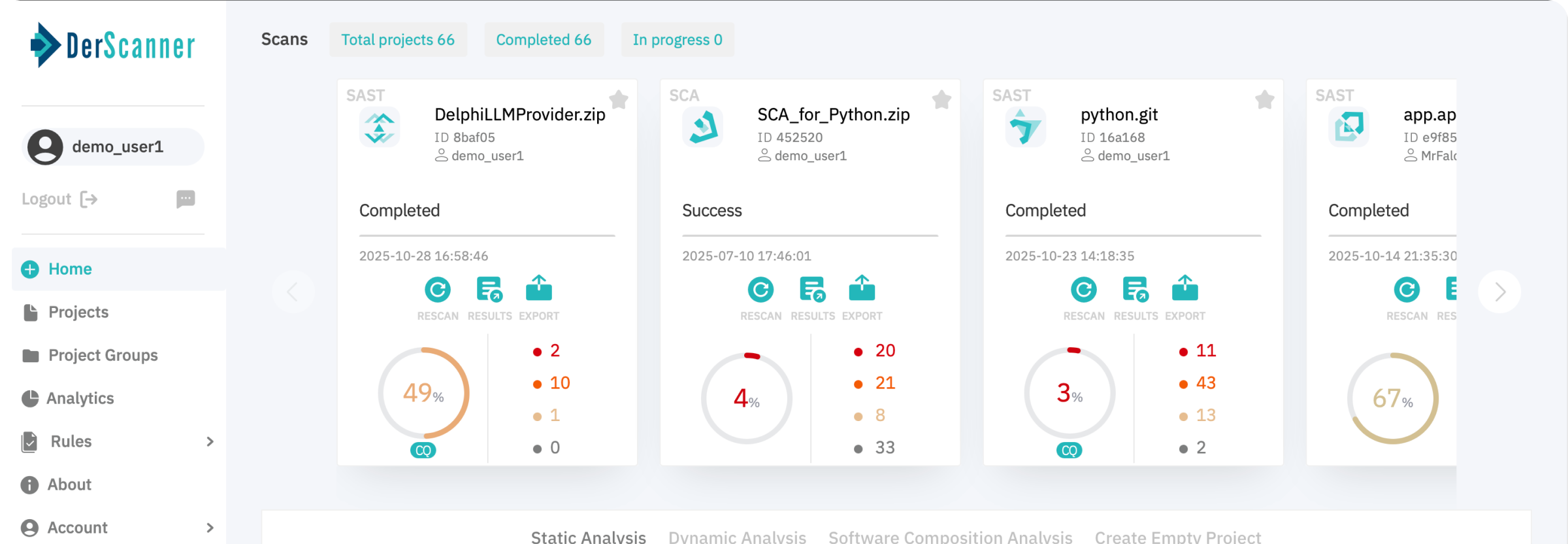
When the tests are finished, the harder part is where the results are: scan reports sit in the scanner, fixes in tickets, SBOMs on the build server. And an auditor wants them for a SPECIFIC application and a SPECIFIC period.
An evidence pack collects these results in one place before the audit. Here's how to build it, step by step.
Step 1. Define which applications and which period the pack covers
Start with a list of applications in scope:
-
for DORA, the ones that support critical or important functions;
-
for PCI DSS, the ones in or connected to the cardholder data environment.
For each application, record the owner, the releases shipped during the audit period and where the code comes from (in-house, supplier or open source).
[NOTE] The audit period matters more than the latest state. An auditor checks that the process worked during the whole period, so the pack needs results for every release in it, not only the last one.
Step 2. Add SAST reports for every release
A SAST report is the proof that the code was reviewed before release. DerScanner SAST maps its findings to OWASP Top 10 2025, CWE/SANS Top 25 2025 and PCI DSS 4.0.1, so an auditor reads the results grouped by the classification the audit refers to.
Export a PDF report for the auditor and a SARIF file for the tools that process results automatically.
Step 3. Add an SBOM and an SCA report for every release
An SBOM is the list of the components inside the application. DerScanner SBOM generation produces a CycloneDX SBOM directly from source code, transitive dependencies included. And DerScanner SCA checks these components for known vulnerabilities and exports the report in PDF, HTML, CSV or JSON.
[IMPORTANT] A completed scan doesn't update itself. If a critical CVE is published after the release, re-scan the saved SBOM and add the new report to the pack.
Step 4. Show how vulnerabilities were fixed over time
A single report shows the state on one day. To show that vulnerabilities were fixed, an auditor needs to compare releases. Scans Comparison in DerScanner shows the new, remaining and fixed findings between two scans, and scan history in each project shows when each scan was run.
For PCI DSS 4.0.1, this comparison helps provide evidence for Requirement 6.3.3, which gives 1 month to install critical patches.
Step 5. Include the event log in the report
DerScanner records actions in a project with timestamps, and the event log can be included in the exported report. So, an auditor reads the results and the record of actions in one file.
Step 6. Explain the findings that remain open
Not every finding is fixed before the release. Some are false positives, and some are accepted risks with a fix planned for a later release. Add a short register of the open critical findings: the finding, the decision, the reason, the owner and the planned fix date.
[IMPORTANT] Under Article 16(3) of RTS 2024/1774, a bank has to adopt an action plan for detected vulnerabilities and monitor how the plan is carried out. A register of open findings with owners and dates is this plan in practice.
How to organize the pack
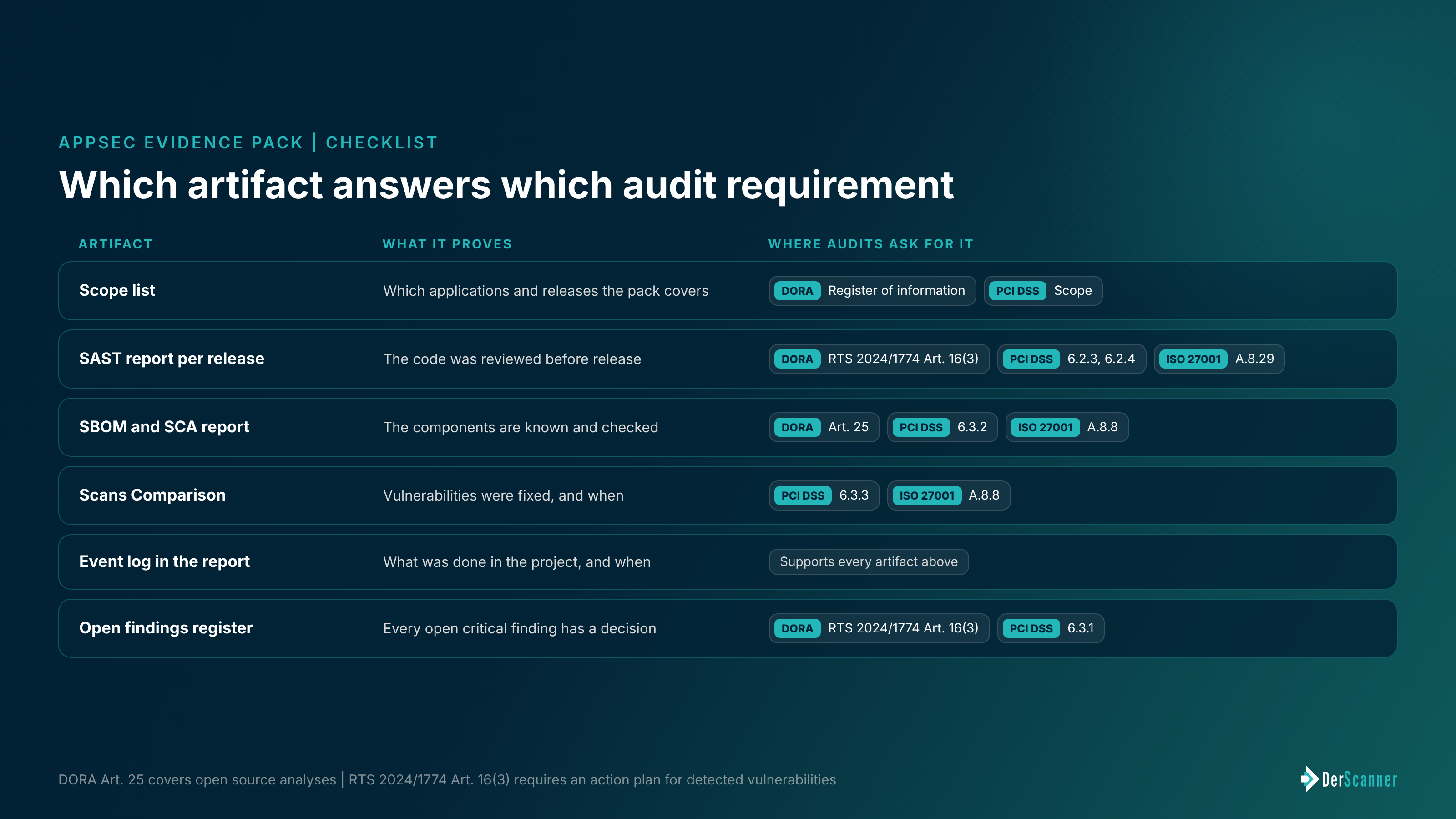
Each DerScanner module exports its own report. So, organize the pack by application: one folder per application, one subfolder per release, and inside it the SAST report, the SBOM, the SCA report and the Scans Comparison with the previous release.
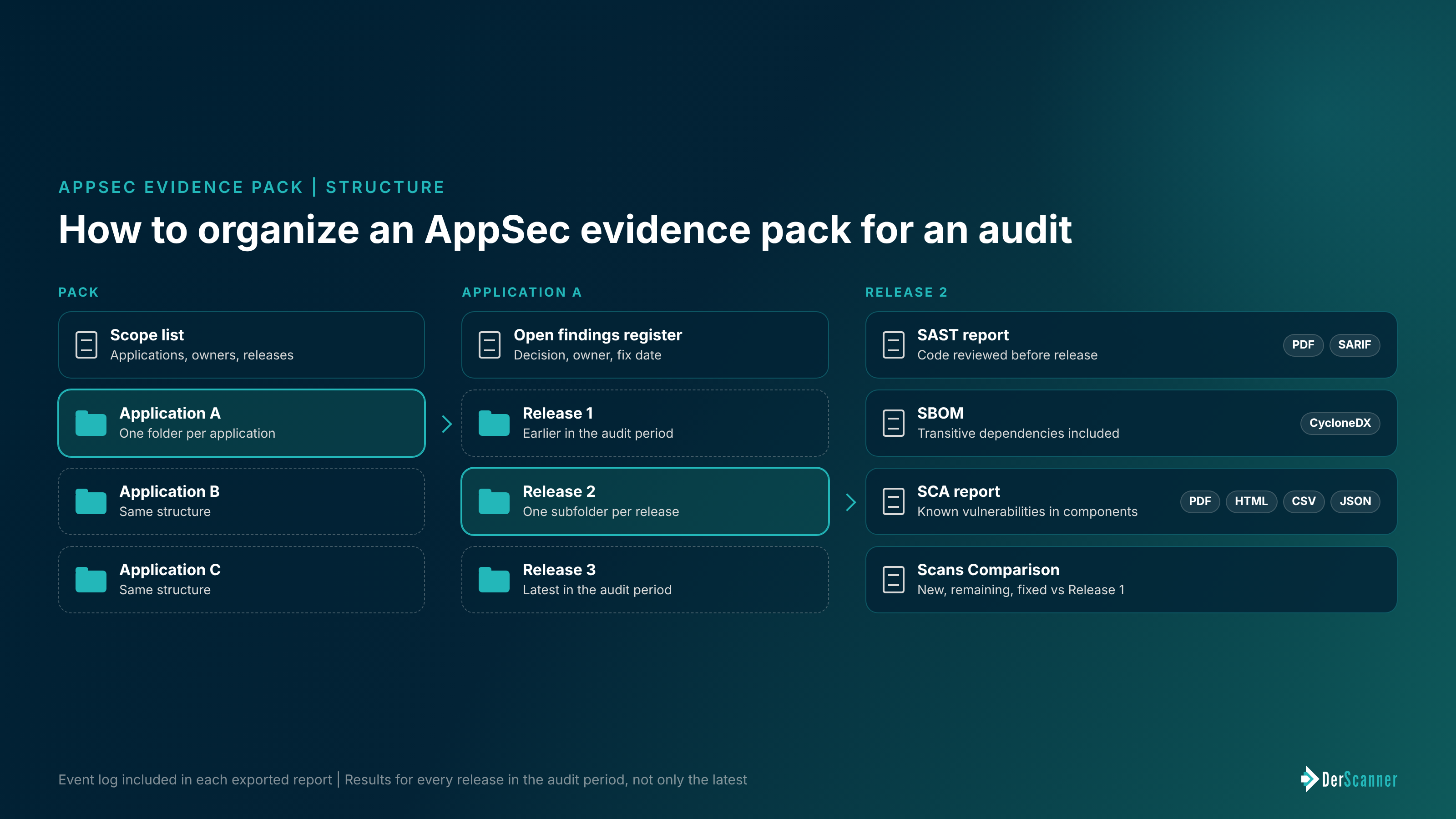
AppSec evidence pack checklist
|
Artifact |
What it proves |
Where audits ask for it |
|
Scope list |
Which applications and releases the pack covers |
DORA register of information, |
|
SAST report per release |
The code was reviewed before release |
DORA RTS 2024/1774 Art. 16(3), |
|
SBOM and SCA report per release |
The components are known and checked |
DORA Art. 25 (open source analyses), |
|
Scans Comparison |
Vulnerabilities were fixed, and when |
PCI DSS 6.3.3, |
|
Event log in the report |
What was done in the project, and when |
Supports all the artifacts above |
|
Register of open findings |
Every open critical finding has a decision |
DORA RTS 2024/1774 Art. 16(3) (action plan), |
If you're preparing for an audit and want to collect this evidence on your own codebase, book a demo or request a PoC. We're always up for a chat.
Ready to Reduce Technical Debt and
Improve Security?
Clean code. Fewer risks. Stronger software