What Is Application Security? Definition, Types, and Testing in 2026
Application security covers the software layer: source code, binaries, dependencies, and runtime behavior. The guide compares the four testing types and explains why Broken Access Control still ranks A01 in OWASP Top 10:2025.
Content
Make Your Applications Secure Today
Sign up for a personalized demo to see how DerScanner can meet your Application Security needs
Verizon's 2026 Data Breach Investigations Report analyzed more than 22,000 confirmed breaches and registered a first: exploitation of vulnerabilities became the most common initial access vector, at 31% of breaches against 20% a year earlier. It overtook phishing and credential abuse. Remediation moved the other way, with 26% of the critical vulnerabilities in the CISA KEV catalog fully patched and the median time to fix stretching from 32 days to 43.
Those defects sit in software that organizations wrote or assembled themselves. That is the layer application security covers.
What application security means
Application security is the practice of designing, building, and testing software so that it resists unauthorized access, tampering, and denial of service. The scope stops at the software layer: source code, compiled binaries, third-party dependencies, and the way the application behaves once it runs. The discipline is usually shortened to AppSec.
Network security handles data in transit and the perimeter around it, through firewalls, intrusion detection, and routing rules. Cloud and infrastructure security cover what sits underneath the application: IAM policies, VPC design, container orchestration settings, host operating systems. Application security stays with the logic developers wrote and the data that logic touches. The boundary starts to matter on the day the perimeter fails, because from that point the application's own controls decide whether an intruder reaches the database.
The five components of application security work
Security applied at a single gate before release produces late and expensive findings. The five components below spread the work across the development life cycle.
-
Access control and authentication. Verified users and services reach only the functions and records assigned to them.
-
Secure coding standards. Developers close SQL injection, cross-site scripting, and buffer overflow paths while writing the code, before review picks them up.
-
Testing across the stack. Automated analysis covers in-house code, external dependencies, and running environments.
-
Runtime protection. A WAF and RASP watch production traffic and block attacks in progress.
-
Compliance and governance. Development aligns with the standards auditors ask about. NIST SP 800-218, the Secure Software Development Framework, supplies a repeatable structure for the four components above.
Why access control comes first
Every major standard opens with authorization. OWASP ASVS devotes chapter V8 to it, and both ISO 27001 and NIST guidance treat it as a baseline. Authentication answers who the user is. Authorization decides what that account may do, and a failure at either point leaves the rest of the software's defenses with nothing to protect.
OWASP Top 10:2025 ranks Broken Access Control at A01, where it has been since the 2021 edition. The category maps 40 CWEs, carries the highest occurrence count in the contributed dataset at roughly 1.84 million findings, and links to 32,654 CVES. Server-Side Request Forgery moved inside it, because an SSRF request reaches a resource the caller was never authorized to touch.
Attackers reach for Insecure Direct Object References and privilege escalation paths because scanners struggle with them. An authorization rule lives in business logic, and a generic ruleset carries no model of who owns which record. Deny-by-default, server-side enforcement, RBAC design, and session invalidation on logout do more for this category than any scanner setting.
The four types of application security testing
No analyzer catches every class of defect, so application security testing runs as four methods with different vantage points.
SAST reads source code, bytecode, or a compiled binary without executing it and reports defects from the inside, early enough that a fix costs one commit. SAST Scanner: A Full Guide covers implementation in detail.
DAST works from the outside against a running application in staging, where server misconfigurations, exposed endpoints, and authentication bypasses become visible.
SCA reads the dependency tree for known CVEs and license terms. The method moved up this cycle: OWASP added Software Supply Chain Failures as a new A03 category with the highest incidence rate on the 2025 list, and Verizon recorded a third party in 48% of breaches, up from 30% the year before. SAST vs DAST vs SCA: Which Security Test Do You Need compares how the three fit into a pipeline.
MAST covers what only appears on mobile: local data storage, certificate validation, platform permissions, and inter-app communication on iOS and Android, assessed against OWASP MASVS.
Where application security work breaks down
Four patterns account for most of the budget spent without a result.
Late testing
Scanning days before a release candidate ships produces delayed deployments, a queue of findings nobody planned capacity for, and remediation at the price it costs once design decisions have set.
Tool sprawl
Static, dynamic, and composition analyzers from different vendors report in different formats and severities. A developer then opens four dashboards to answer one question about one service, and duplicate findings across tools consume triage time that produces nothing.
Alert fatigue
False positives teach engineers to distrust the queue, and once that happens real findings sit in the backlog next to the noise. Tuned rulesets and correlation between analyzers restore the signal, a practice covered in Reducing SAST False Positives.
No evidence for the audit
A scanner reports a technical defect. The audit team asks for proof that a control operated on every release across a period, and findings that never take that shape leave someone assembling screenshots by hand the week before the assessment.
What consolidation changes
Centralized visibility, one ruleset across teams, and results delivered into the CI/CD and IDEs already in use remove most of what the four patterns cost. Policy enforcement then runs on the pipeline developers work in, and the security team stops arbitrating between dashboards that disagree.
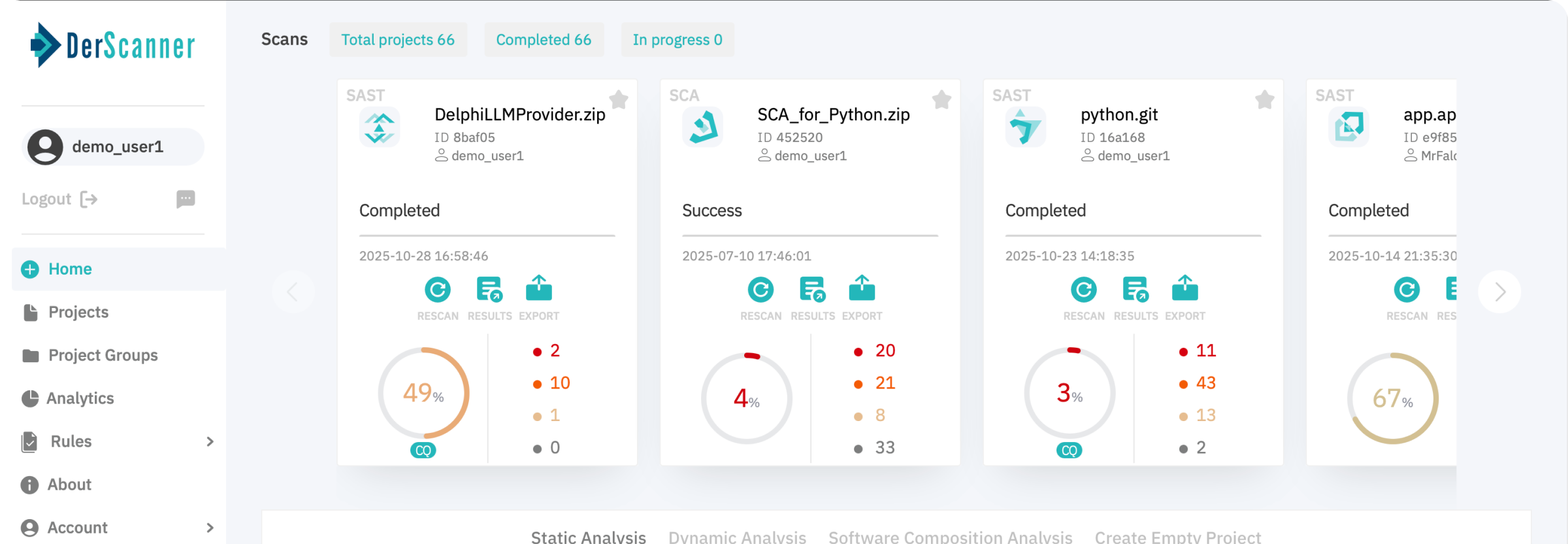
DerScanner runs SAST, DAST, SCA, MAST, and binary analysis from a single platform, deployed on-premise or in an air-gapped network, across 43 languages including legacy stacks. SAST and binary analysis findings carry their mapping to OWASP Top 10 2025, CWE/SANS Top 25 2025, and the OWASP API Security Top 10, which gives the audit team a documented source when PCI DSS 4.0.1 or ISO 27001 evidence comes due. Request a demo to run a proof of concept on the organization's own infrastructure.
Ready to Reduce Technical Debt and
Improve Security?
Clean code. Fewer risks. Stronger software