Application Security in Cloud Native Environments: A Practical Overview
Why stop treating cloud native security as an afterthought? While Kubernetes gives speed, it also erases perimeter and invites a 742% spike in supply chain attacks. The only real protection left is embedding automated security scanning directly into code, dependencies, and build pipeline.
Content
Make Your Applications Secure Today
Sign up for a personalized demo to see how DerScanner can meet your Application Security needs
According to the CNCF 2024 survey, an overwhelming 96% of organizations are either currently using or actively evaluating Kubernetes to manage their containerized workloads. Concurrently, the SonatypeState of the Software Supply Chain report indicates that software supply chain attacks have increased by an astonishing 742% over a three-year period. This striking paradox highlights the core dilemma of modern software engineering: while rapid, containerized deployment models drive incredible business agility and scalability, they simultaneously expose organizations to unprecedented, highly complex vulnerabilities. Establishing robust cloud native application security is no longer an optional compliance exercise; it is a fundamental prerequisite for operating safely in distributed environments where traditional perimeter-based defenses are entirely obsolete.
Why Cloud Native Changes the AppSec Model
The transition to the cloud fundamentally alters how applications are architected, deployed, and ultimately secured. According to the CNCF Cloud Native Definition, this new computing paradigm relies heavily on immutable infrastructure, declarative APIs, and dynamic container orchestration. Consequently, the traditional, static network perimeter has completely disappeared. Infrastructure is now defined entirely as code (IaC), meaning a single typographical error or misconfiguration in a Git repository can instantly expose an entire production environment to the public internet.
This profound architectural shift expands the potential attack surface area. Instead of a large, monolithic application running on a single secure server, modern software architectures rely heavily on microservices security, where hundreds of loosely coupled, independent components communicate across complex, interconnected networks. This decentralization introduces entirely new cloud native security challenges, such as securing service mesh communications, managing decentralized identity and access management (IAM) roles, and ensuring that consistent container security policies are maintained across transient, ephemeral workloads that may only exist for a few minutes. The complexity of these deployments is so significant that managing cluster-level risks now requires adherence to highly specific threat frameworks, such as the OWASP Kubernetes Top 10.
The Four Layers of Cloud Native Security
Effectively mitigating these distributed vulnerabilities requires a structured, defense-in-depth methodology often referred to as the 4C's: Cloud, Cluster, Container, and Code. However, from a strict software development lifecycle (SDLC) perspective, a comprehensive cloud native application protection strategy must focus heavily on the underlying building blocks across four primary execution layers:
While broader infrastructure monitoring tools like a CNAPP (Cloud-Native Application Protection Platform) might aggregate high-level visibility across these operational areas, the true foundation of cloud native AppSec relies on proactively securing the source code, open-source dependencies, and compiled binaries long before the application reaches a production server.
Where SAST, SCA, and DAST Fit in a Cloud Native Pipeline
To improve security for cloud-native app platforms without stalling developer velocity or creating operational bottlenecks, organizations must integrate automated security testing directly into their Continuous Integration and Continuous Deployment (CI/CD) pipelines. Understanding the nuances of SAST vs DAST vs SCA: Which Security Test Do You Need is crucial for building an efficient, automated workflow.
Static Application Security Testing (SAST) operates at the earliest possible stages of development. Implementing SAST in SDLC means scanning the source code upon every developer commit or pull request, providing immediate, actionable feedback on syntax errors and logical flaws. Software Composition Analysis (SCA) is typically triggered slightly later, during the automated build phase. Advanced SCA tools go beyond simple version checking by utilizing deep reachability analysis to determine if a vulnerable open-source function is actually called and executed by the proprietary code. For a deeper understanding of how these two static methodologies complement each other, security teams should review the principles of SCA vs SAST. Finally, Dynamic Application Security Testing (DAST) runs after the application is successfully deployed into a staging or QA environment, interacting with the running microservices to identify server configuration flaws and authentication bypasses that static, code-level tools cannot perceive.
The Supply Chain Problem
In a modern microservices architecture, an application is only as secure as its weakest external dependency. The highly publicized compromise of popular package repositories, such as npm, RubyGems, or PyPI, has demonstrated exactly how easily malicious code can be distributed globally. Threat actors no longer need to execute complex network intrusions to hack an enterprise directly; they simply use techniques like typo-squatting or dependency confusion to poison an open-source library that the enterprise unknowingly downloads during an automated pipeline build process.
To combat this systemic threat, generating and meticulously managing a Software Bill of Materials (SBOM) has become a minimum security baseline for any organization. An SBOM acts as a comprehensive, machine-readable inventory of all software components, allowing security operations teams to respond instantly when a new zero-day vulnerability is announced. Furthermore, emerging global regulations, such as the European Union's Cyber Resilience Act (CRA), mandate strict reporting requirements and lifecycle vulnerability management protocols for software publishers, making supply chain transparency a strict legal necessity rather than an optional best practice.
Cloud Native Doesn't Mean SaaS-Only
A common misconception in the industry is that utilizing modern, cloud-centric development architectures inherently requires the adoption of cloud-based security tools. However, for organizations operating within highly regulated industries—such as banking, healthcare, government, and defense—data sovereignty, intellectual property protection, and strict privacy controls are absolutely paramount. Transmitting proprietary source code, critical infrastructure configurations, or sensitive vulnerability data to a third-party Software-as-a-Service (SaaS) vendor is often a direct violation of internal compliance policies and external data localization laws.
Therefore, on-premise security solutions remain an absolute operational requirement. The most effective security platforms are entirely capable of integrating seamlessly into modern, containerized pipelines while operating fully within an air-gapped, zero-trust, or self-hosted environment. This structural control ensures that highly sensitive intellectual property never leaves the corporate perimeter, even while engineering teams leverage the most advanced orchestration technologies available.
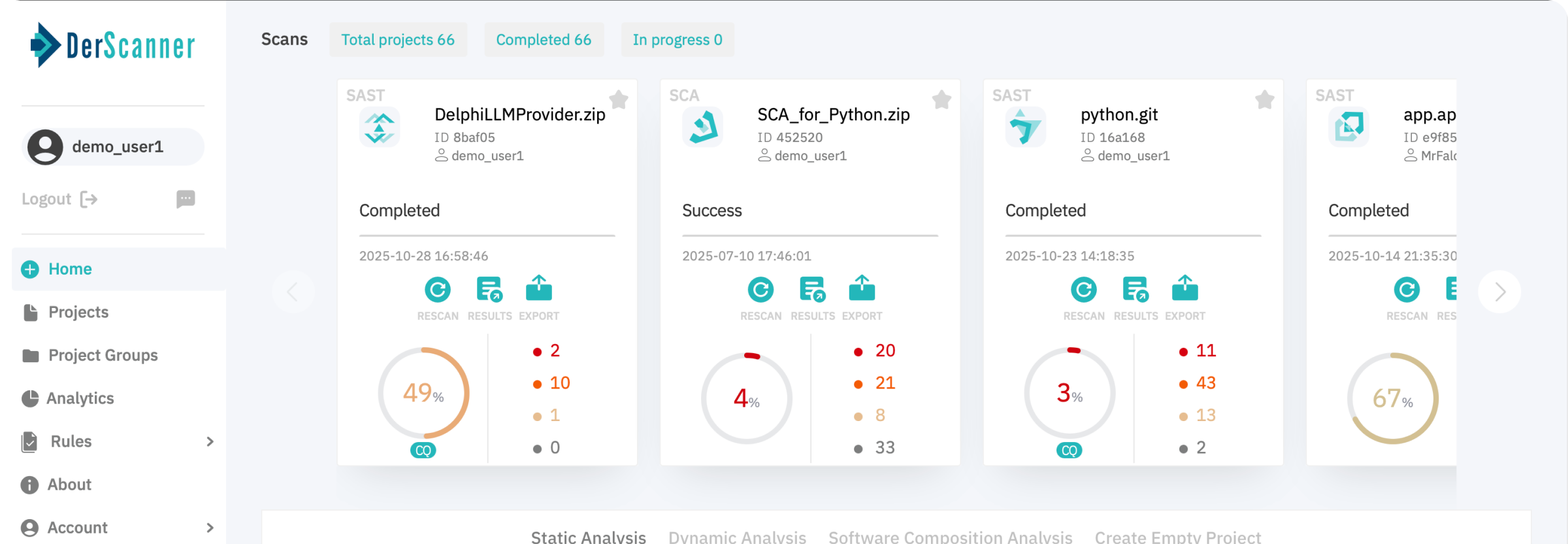
Securing these complex architectures requires a unified, developer-friendly approach that eliminates fragmented toolchains and persistent alert fatigue. For organizations seeking a copliace-friendly AppSec platform that addresses the code, dependency, and binary security layers without compromising data privacy, DerScanner provides deep, actionable visibility into modern workloads. By offering complete on-premise and air-gapped deployment options alongside highly precise vulnerability detection, it enables enterprise engineering teams to maintain high-velocity software deployments while strictly adhering to the most rigorous corporate compliance and security mandates.
Ready to Reduce Technical Debt and
Improve Security?
Clean code. Fewer risks. Stronger software